EN HU


Philip de László's Technique

Early Method
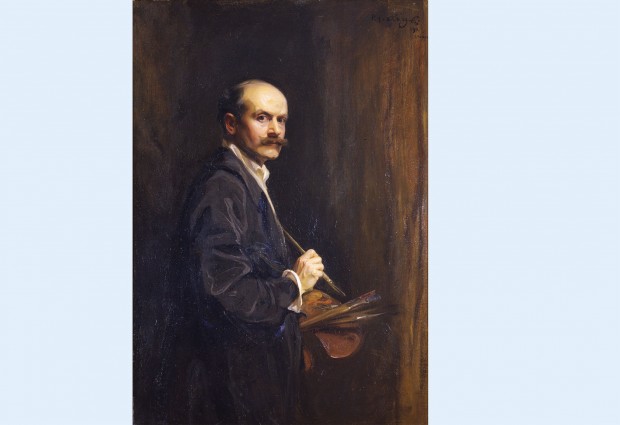
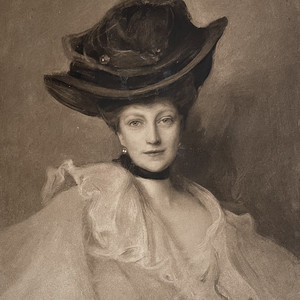
By the time de László finished his training as an artist, having studied in Budapest, Munich, and Paris, he drew and painted with great skill and dexterity. However, at the outset of his career, he would still make worked-up portrait drawings, often life-size, as preparatory works, and would later meticulously use these to paint the finished portrait. Preparatory works for the group portraits of the de Gramont and Kupelwieser families, respectively painted in 1902 and 1905, bear testimony to de László’s early method. He would then draw the whole figure in detail on the canvas before starting to paint. The artist later commented on his early method, saying that it was “the way of youthful inexperience and uncertainty”.[1]
 
Painting a Portrait
In 1934, de László was asked to make a book about his technique with his friend, the artist and art critic Alfred Lys Baldry. In the resulting work, Painting a Portrait,[2] de László explained that the colours of his palette were, “in the order in which [he] put them on his palette – ultramarine, madder, rose madder, zinc white, light cadmium, dark cadmium, yellow ochre, burnt sienna” and, when there was a particular reason, “[he] add[ed] to them ivory black, Veronese green, Lac garance and orange cadmium”.[3]
He used poppy oil as a medium, because it dried slowly and suited his alla prima technique. He avoided as far as possible mixing more than two colours together on the palette at any time “for the sake of purity”. Instead he applied individual hues “wet in wet” directly onto the canvas.


De László would then do a rapid sketch, in charcoal or pencil, to determine the composition of the painting. Especially for his most important commissions he would make a similar sketch in oil for three-quarter length, full-length, or group portraits “to judge the effect of the colour scheme”.[4]
 

The initial sketch, and de László  "drawing with his brush". All the images on this page are reproduced from Painting a Portrait


He started on a blank canvas, in its frame (see below), “painting a few lines to indicate the placing of the figure on the canvas”, before focusing on the head, “seeking to express by means of light and shade the construction of the skull and defining accurately the larger planes”[5] in “a process of gradual building up […] [which] must be done rapidly and directly.”[6] To use his favourite expression, he would “draw with [his] brush” to develop the likeness. Before finishing the head, de László would then paint the surroundings of the sitter to guarantee the harmony of the composition, but always in relation to the head. Once the head was finished, he moved on to the sitter’s hands and feet, if shown, and then to the rest of the body.
If and when de László was unhappy with the portrait, he would often abandon the canvas or board to start afresh on a new one, occasionally on the verso of an existing abandoned work.
 

Head and accessories receive almost simultaneous attention to achieve unity of effect

Using the mahl-stick as a support for the hand, the artist applies detailed touches

The portrait after three hours' work

 The portrait after six hours' work

 Work on hands and arms

 Gwen Ffrangcon-Davies, the artist, and the completed portrait


Study Portraits
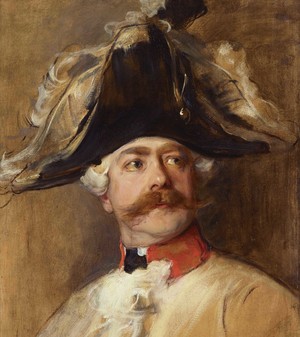
De László is well known for his study portraits or portrait sketches, as he would sometimes call them. The particularity of these works was that they were generally painted on unprimed millboard, or "artist’s board", and deliberately left “unfinished”, that is with the composition finely but freely painted, but apparently floating upon a plain background. They exemplified de László’s fluid technique and vigorous brushwork, and are unique to his oeuvre. He considered them as a sub-genre of portraiture. In this respect, it was not unusual for commissioners to ask specifically for study portraits, especially from the 1920s, not least because he could paint these portraits at great speed, in one or two sittings, taking perhaps no more than two hours. Letters from the artist’s archive suggest that he had those boards shipped from Munich, from Dury & Konrad Barth’s, even until the mid-1920s.[7]


Click here to see some footage of de László painting the portrait of a mannequin from "Lucile"


Frames
De László felt that the frame formed an integral part of the portrait, and to ensure its complete harmony, he would almost systematically paint the canvas in its frame. De László usually asked his commissioner whether he/she had a suitable antique frame in their collection, but if it was not the case, he would recommend a frame from Emile Remy (153 King’s Road London S.W.) or Buck. However, in a letter dated 1934, de László wrote to Lord Airlie: “I would propose to get the frame from A. Martin, of 45 Lawn Road, N.W.3 who is usually more moderate than Pynappel, who is the very best, or some of the others”.[8] When working in Paris, de László always entrusted Edouard Grosvallet with his paintings.
 
 
Varnishing
De László did not always varnish his portraits himself, especially as he got busier and busier. However, when picture owners asked him what had to be done with their portraits, he systematically recommended that they be varnished professionally with Vibert “vernis à retoucher”.

[1] Rutter, Owen, Portrait of a Painter, London, 1939, p.135
[2] Holme, C.G., ed., Painting a Portrait by de László, in How To Do It Series No.6, Introduction by A.L. Baldry, The Studio, 1934
[3] Ibid., p.12
[4] Ibid., p.16
[5] Ibid., p.18
[6] Ibid., p.18
[7] DLA015-0028, letter from Mrs Carl Valentin to de László, 29 February 1924; DLA003-0071, letter from Frederick Cullen to de László, 9 September 1914
[8] DLA052-0056, letter from de László to Lord Airlie, 31 December 1934