Exhibitions
Philip de László, a Special Display
27 March - 5 September 2010, National Portrait Gallery, London, room 33
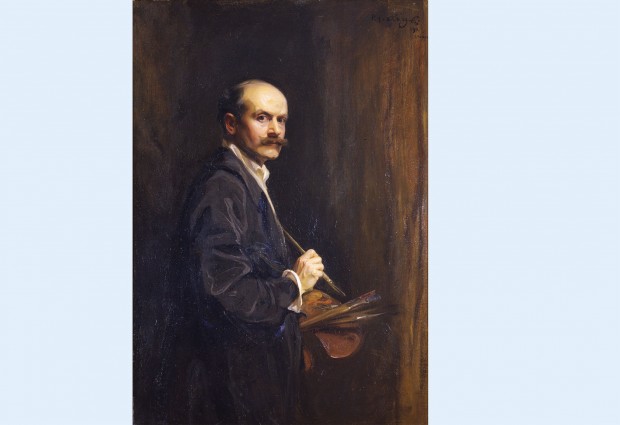
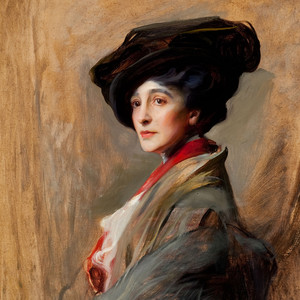
Organised with the participation of the de Laszlo Foundation, the display combines several important loans with paintings from the National Portrait Gallery's own collection and has a dual focus. This sheds light on de László's achievements as a painter of important commissioned portraits but also on a much less well-known aspect of his work: his intimate private portraits of family and close friends. Highlights of the 'public' portraits include those of Winifred, Duchess of Portland, and the Duchess of York. Painted in 1912 and 1925 respectively, the portraits are bravura examples of de László's mature style in which fluid brushwork carries arresting images of sophisticated characterisation. In compelling contrast are three portraits of his sons John and Stephen, completed in 1918-1919. These touching evocations of childhood and youth illuminate the subtle depth that underpins the work of this remarkable painter (Paul Moorhouse, NPG Curator 20th century)
![]() |
![]() |
|
Her Late Majesty the Queen Mother |
The First Drawing Lesson, 1919
|
For more information, click here
Munich
The exhibition illuminated a hitherto unexplored aspect of Hungarian painting in the second half of the 19th century. While it is common knowledge among art historians that in those days most of the young Hungarian artists went to study in Munich, in the absence of an art academy at home, the actual influence on artists of the Academy and of the city as an international centre of art remains largely unassessed.
From the late 1850s, history painting was the genre that had the greatest influence on the style of our artists; three of the most well known Hungarian painters, namely, Sándor Wagner, Sándor Liezen-Mayer and Gyula Benczúr did, in fact, hold teaching positions at the
Philip de László studied at the
Three genre pictures and two portraits by Philip de László were included in the exhibition:
The Hofbraühaus, 1892, Hungarian National Gallery
Ave Maria or Vesper Bell, 1895, Hungarian National Gallery
Rural Landscape with a Couple, 1893, Private Collection
H. E. Cardianal Mariano Rampolla, 1900, Hungarian National Gallery
János Fadrusz, 1901, Hungarian National Gallery
![]() |
![]() |
| Rural Landscape with a Couple, 1893 | János Fadrusz, 1901 |
Van Dyck and Britain
18 February - 17 May 2009, Tate Britain
This visually sumptuous exhibition brought together some of the finest and most magnificent paintings that van Dyck produced during his years in Britain. It also revealed his continuing visual legacy through portraits by artists from the eighteenth to twentieth centuries, including Sir Joshua Reynolds and John Singer Sargent. Featuring loans from The Royal Collection and The National Trust, this exhibition explored the context of van Dyck’s key English works, examining his innovative approach to painting the British elite. It also looked at his use of costume and his luscious, sparkling depiction of the rich fabrics of the period, and how his art was itself influenced by more local British painting.
The portrait of Mrs Sandys by Philip de László was included in the exhibition:
|
|
|
Mrs George Owen Sandys, 1915 |
Click here for more information on the exhibition
A Future for the Past. Petrie's Palestinian Collection
9 January - 24 March 2007, Brunei Gallery, SOAS, London
This unique exhibition celebrated the diversity of ancient Palestine. It also illustrated the deep, rich heritage of a region repeatedly portrayed in today's media as a place of conflict and suffering.
The exhibition highlighted the extraordinary finds made by the archeologist Sir Flinders Petrie, who was Professor of Egyptology at UCL and spent many years working in the area around modern Gaza in the 1920s and 1930s.
Two portraits of Professor Flinders Petrie by Philip de László were included in the exhibition:
|
|
The Hungarian Soul. Romantic and Realism in the land of the Magyars
13 August 2006 - 11 February 2007, Kunst Halle, Krems
Hungarian painting of the nineteenth century reflects the history of a people that, after 150 years of Turkish rule still felt the yoke of domination under the Habsburgs. The bloody suppression of the revolution of 1848/49 crushed the hopes of a better future for a long time.
The pathos of the fight for freedom and the yearning for independence are the main subjects of Hungarian pictures, most impressively represented by Mihály Munkácsy, probably the most important Hungarian painter of the century.
The ‘Hungarian soul’, with its combination of long suffering, the lament of centuries of foreign domination and an insistent call for freedom, could clearly be seen in the monumental exhibition in Krems.
Three genre paintings by Philip de László were on show at Krems:
Click here to visit the museum's website
|
||||
|
|
|||
Hungarian Splendour: Masterpieces from the National Gallery in Budapest
23 September 2006 - 7 January 2007, Art Gallery of Hamilton, Ontario
A stunning 75-work selection of Hungary's beloved nineteenth-century paintings, spanning the entire century and including stellar examples of history painting, distinguished portraiture, landscape and genre scenes.
This exhibition included two examples of Philip de László's works, the portrait of Pope Leo XIII, and the genre painting Ave Maria:
|
|
Click here to visit the gallery's website
De László in Holland, an Exhibition of Dutch Masterpieces
from Private Collections

|
A few books remain. To order a copy, please contact:
Paul Holberton Publishing |
![]() |
A Brush with Grandeur
![]()
|
This exhibition was held at Christie’s (www.christies.com) in January 2004, presented by the Hungarian Ministry of Cultural Heritage as part of Magyar Magic, the Festival of Arts arranged by the Hungarian Cultural Centre in London, November 2003-November 2004. It was a resounding success and indicated that de László’s life and work has enormous appeal. This exhibition attracted some 17,000 people in just 17 days. About one in five visitors purchased the book produced on the occasion of the exhibition, which, as resulting correspondence shows, appealed to art historians and historians alike and to a multitude of owners and other interested parties. Paul Holberton Publishing: www.paul-holberton.net |
![]() |
Other Exhibitions
|
The Trust effects the introduction of pictures to exhibition curators to facilitate loans, such as to Andrew Wilton’s magnificent Swagger Portrait show, held at the then Tate Gallery: 1992-1993 (Tate Britain). Tate Britain Tate Online |
|
|
||||
|
|